Full-Stack Architecture for Real-Time Products Using WebSockets and Event Streams

Real-time products have become the default expectation in many industries. Users want live chat that feels instant, dashboards that refresh without manual reloads, and notifications that arrive the moment something changes. Building these experiences requires more than adding a real-time library to an existing application. It demands an architecture that supports continuous data flow, low-latency communication, reliable delivery, and graceful scaling. WebSockets and event streams are two core building blocks for this. When used together, they create a strong foundation for real-time products that remain responsive under varying loads.
Learning to design such systems is increasingly relevant for developers who want to build production-grade real-time apps. Many professionals begin exploring these patterns during a full stack developer course in hyderabad, where the focus moves beyond basic CRUD apps into modern application architecture.
WebSockets: The Real-Time Connection Layer
WebSockets provide a persistent, full-duplex connection between the client and server. Unlike traditional HTTP, where the client must repeatedly request updates, WebSockets keep a channel open so data can move both ways instantly. This makes them ideal for real-time interactions such as chat, multiplayer collaboration, live support tools, and streaming updates.
From an architectural view, the WebSocket server acts as the connection manager. It must handle thousands of concurrent connections, track user sessions, and route messages to the correct recipients. This introduces design decisions such as:
- Connection lifecycle handling: connect, authenticate, keep-alive, reconnect
- Message routing: user-to-user, user-to-room, topic-based broadcast
- Backpressure strategies: what to do when clients cannot consume updates fast enough
- State management: where to store connection metadata and subscription maps
WebSockets are powerful, but they are not a complete real-time architecture on their own. They solve the “live connection” problem, but they do not automatically provide durable event processing, replay, or scalable fan-out across multiple server instances. That is where event streams become essential.
Event Streams: The Backbone for Scalable Change Propagation
Event streams are designed to capture and distribute changes as a sequence of events. Instead of a system directly calling other services for every update, services publish events such as “OrderPlaced”, “PaymentConfirmed”, or “DeviceStatusUpdated”. Other services subscribe and react independently. This approach reduces tight coupling and improves scalability.
Event streaming platforms support high-throughput message ingestion, ordered logs, consumer groups, and retention policies. These features allow systems to handle bursts of activity without collapsing under load. They also enable rebuilding the state by replaying events, which is valuable for debugging and recovery.
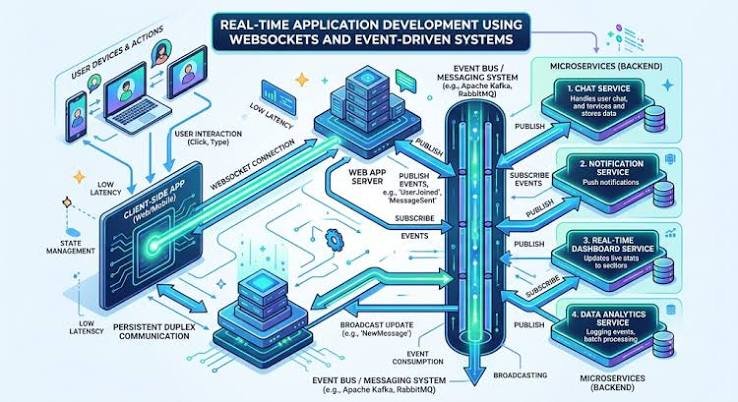
In full-stack real-time products, event streams often sit behind the WebSocket layer. The backend publishes domain events to the stream. A dedicated real-time delivery service then consumes those events and pushes relevant updates to connected clients through WebSockets. This creates a clean separation:
- Business services publish events
- The streaming layer distributes events reliably
- Real-time gateway converts events into client-facing messages
- Clients receive and render updates instantly
This pattern avoids the mistake of turning WebSocket servers into monolithic systems that handle every concern from business logic to message durability.
Putting It Together: Reference Architecture for Real-Time Products
A practical architecture for real-time products combines WebSockets and event streams in a layered model.
Client Layer
The frontend establishes a WebSocket connection after authentication. It subscribes to topics such as user notifications, chat rooms, or dashboard metrics. The client also sends events such as “typing”, “message send”, or “filter change”.
API and Service Layer
HTTP APIs still play an important role for commands, initial state loading, and non-real-time operations. For example, a dashboard can load historical data over HTTP and then receive incremental updates over WebSockets. Services validate commands, update the database, and publish events to the stream when state changes.
Streaming Layer
The event stream acts as the distribution hub. It ensures that services do not need to know which clients are connected or which WebSocket instance should deliver updates. Events are retained for a configured period, supporting replay and downstream processing.
Real-Time Gateway
This component consumes events from the stream and pushes them to clients. It maintains subscriptions and maps them to event types. It can also enrich or filter events so clients only receive what they need. This reduces bandwidth usage and improves user experience.
Developers studying architecture patterns in a full stack developer course in hyderabad often see this gateway approach because it scales better than directly connecting business services to client sockets.
Reliability, Security, and Testing Considerations
Real-time systems can fail in subtle ways, so reliability must be designed in from the start.
- Delivery guarantees: Decide whether updates require at-most-once, at-least-once, or exactly-once behaviour. Many real-time UIs can tolerate occasional duplicates if messages are idempotent.
- Ordering: Some updates require strict order, especially for chat or trading-style events. Use partitioning strategies that preserve ordering where needed.
- Authentication and authorisation: WebSocket connections must be authenticated, and topic subscriptions should be authorised to prevent data leaks.
- Observability: Track connection counts, message latency, event lag, and error rates. These metrics are essential for diagnosing performance issues.
- Load testing: WebSocket concurrency testing is different from HTTP testing. Simulate connection churn, reconnect storms, and bursty event streams.
A common best practice is to treat client messages and backend events as structured contracts, with clear schemas and versioning. This prevents breaking changes when services evolve.
Conclusion
Full-stack real-time products require an architecture that balances speed, scale, and reliability. WebSockets provide the live delivery channel, while event streams provide the durable backbone for distributing changes across services and instances. When combined thoughtfully through a real-time gateway pattern, teams can build systems that remain responsive, resilient, and easier to evolve over time. For developers aiming to create production-grade real-time applications, understanding this architecture is a valuable skill that extends well beyond simple socket implementation.