Stateless vs. Stateful Architectures: Orchestrating Consistency in Global-Scale Web Systems

As web systems grow to serve millions of users across multiple regions, architects must make fundamental decisions about how their applications manage data and session information. One of the most consequential choices is whether to build a stateless or stateful architecture. Each approach handles client data differently, carries distinct trade-offs, and suits different use cases. Understanding these differences is essential for building systems that are scalable, reliable, and consistent. This article explains both architectural patterns, compares their strengths and limitations, and outlines how modern systems combine them to meet global demands.
What Is a Stateless Architecture?
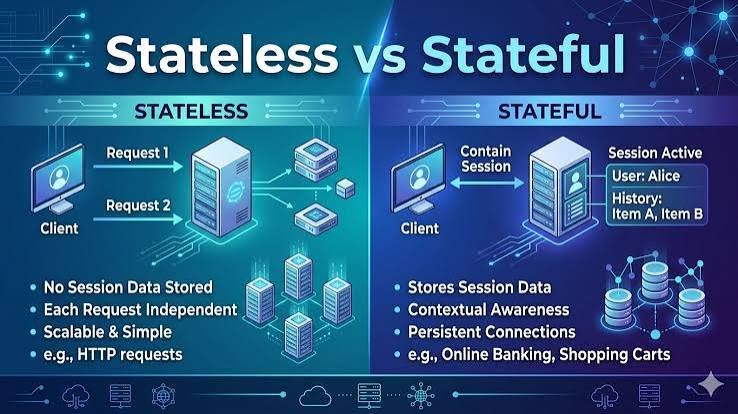
In a stateless architecture, each client request contains all the information the server needs to process it. The server does not retain any memory of previous interactions. Once a request is handled and a response is sent, the server discards any associated session data.
This design principle is a cornerstone of REST (Representational State Transfer) APIs. Each HTTP request is self-contained, carrying authentication tokens, query parameters, and any other context the server requires. Because no session data is stored on the server side, any instance in a server pool can handle any incoming request equally well.
The primary advantages of stateless design are simplicity and horizontal scalability. Adding more servers to a stateless cluster is straightforward because there is no need to synchronise shared session data between instances. Load balancers can distribute traffic evenly across all available nodes without routing users to a specific server.
Stateless services are also easier to recover from failure. If one instance crashes, another immediately picks up subsequent requests without any loss of session context because that context was never held on the server to begin with.
What Is a Stateful Architecture?
A stateful architecture maintains persistent session data on the server between requests. The server remembers who a client is and what they have done in previous interactions. This allows the application to provide continuity across a session without requiring the client to resend all context with every request.
Traditional web applications often relied on stateful servers that stored session objects in memory. A user who logged in would be recognised on subsequent page loads because their session was held server-side. This approach works well for smaller applications but creates significant challenges at scale.
The key limitation is session affinity, also known as sticky sessions. When session data lives on a specific server, the load balancer must route all requests from a given user to that same server. If that server fails, the session is lost. Scaling out also becomes more complex because migrating or replicating session data across servers requires careful coordination.
Stateful components are still essential in many systems, particularly for databases, message queues, and distributed caches. The question is not whether to use state, but where to hold it and how to manage it reliably.
Consistency Challenges in Global-Scale Systems
Global-scale systems amplify the complexity of both architectural patterns. When servers are distributed across data centres in different geographic regions, maintaining consistency becomes a significant engineering challenge.
For stateless services, the challenge lies in ensuring that the shared data stores they rely on, such as relational databases or distributed caches like Redis, remain consistent across regions. Techniques such as read replicas, eventual consistency models, and conflict resolution strategies are commonly used to address this.
For stateful components, global distribution introduces the risk of split-brain scenarios, where two nodes in different regions each believe they hold the authoritative version of the data. Consensus protocols such as Raft and Paxos are used to coordinate state changes across distributed nodes and prevent inconsistency.
The CAP theorem is fundamental here. It states that a distributed system can guarantee only two of three properties simultaneously: consistency, availability, and partition tolerance. Architects must make deliberate trade-offs based on application requirements, accepting eventual consistency where strict consistency is not critical.
Developers who complete a full stack developer course in Pune are exposed to these architectural principles and learn how to apply them when designing and building production-grade distributed systems.
Combining Both Approaches in Modern Systems
Most production web systems at a global scale do not choose one pattern exclusively. Instead, they adopt a hybrid model. The application layer is typically kept stateless to support horizontal scaling and fault tolerance. State is externalised to dedicated infrastructure components that are purpose-built for managing persistence reliably.
For example, a stateless API server might authenticate requests using JWT tokens, which carry all necessary session context in a signed payload. User preferences and transactional data are stored in a distributed database. Real-time session data, such as shopping cart contents, might be held in a distributed in-memory store like Redis, which is itself a stateful component but managed separately from the application tier.
This separation of concerns allows each layer to scale and fail independently. Engineers who invest in a full stack developer course in Pune learn how to design and implement these layered architectures effectively, gaining practical skills in building APIs, configuring distributed caches, and integrating databases into scalable system designs.
Conclusion
Stateless and stateful architectures represent two complementary approaches to managing data in web systems. Stateless design enables horizontal scaling and simplifies fault recovery, while stateful components provide the persistence and continuity that applications depend on. At global scale, the key is not choosing between them but knowing how to orchestrate them together. By externalising state to dedicated infrastructure and designing application tiers to be stateless, engineering teams can build systems that are both consistent and capable of handling millions of requests reliably.